
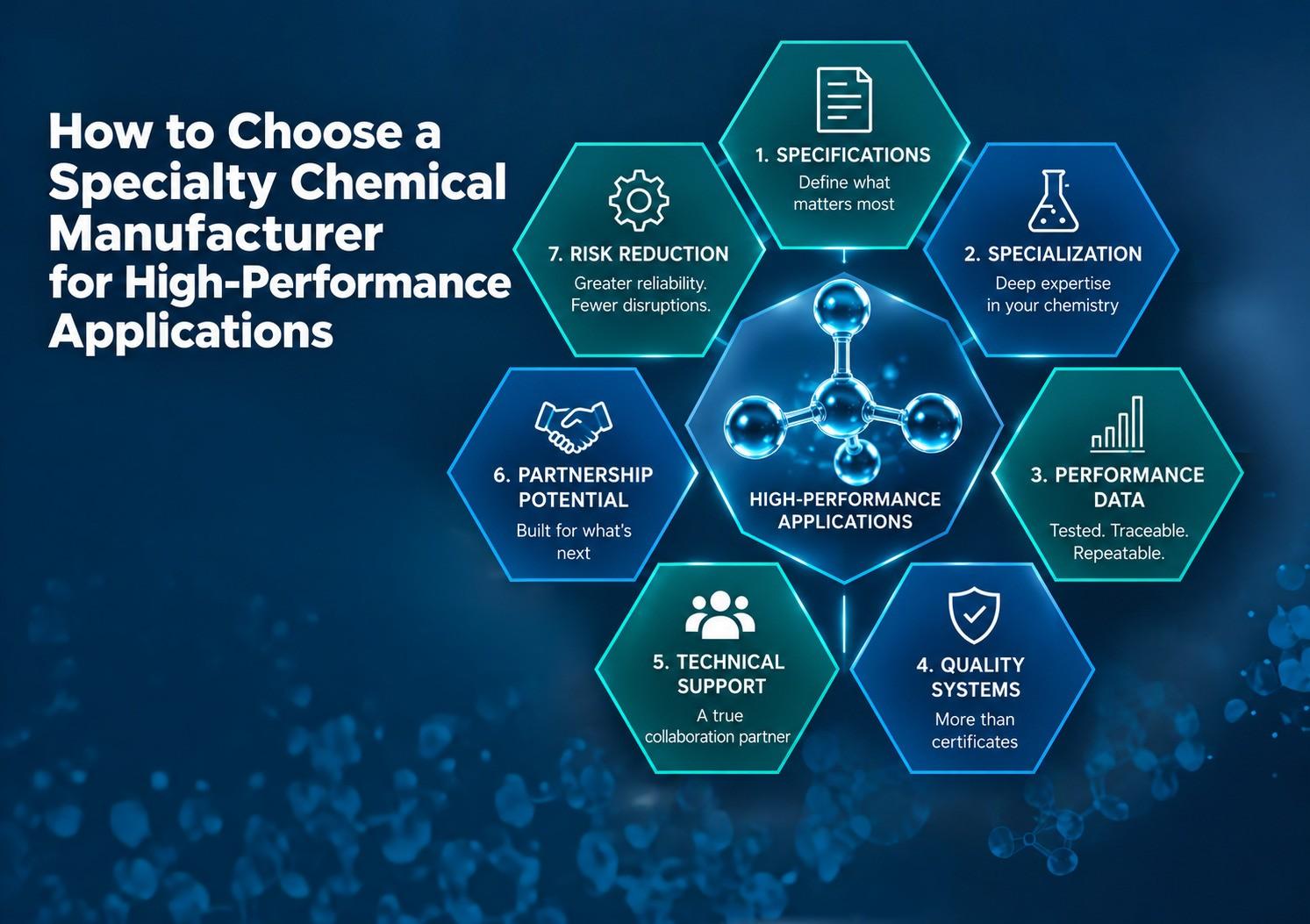
How to Choose a Specialty Chemical Manufacturer for High‑Performance Applications
Choosing the right specialty chemical manufacturer is ultimately about one thing: consistent, application‑specific performance. For high‑performance markets, such as electronics, aerospace, advanced composites, fire retardants, and engineered materials, the wrong supplier can introduce variability, compliance risks, and costly production delays. The right partner becomes a long‑term technical ally.
Why Choosing the Right Specialty Chemical Manufacturer is Important
High‑performance applications demand tight specifications, repeatable quality, and verified performance data. Specialty chemicals aren’t commodities; they’re engineered materials where purity, consistency, and formulation accuracy directly determine product reliability.
Industry data shows that specialty chemicals are purchased for performance, not volume, and each vertical (coatings, electronics, aerospace, water treatment, flame retardants) has distinct specification gates.
Procurement teams increasingly evaluate suppliers on technical capability, compliance, and long‑term reliability, not just price.
1. Start With Your Non‑Negotiable Specifications
Before sending an RFQ, define the three to five properties you absolutely cannot compromise on. This is especially critical for high‑performance applications where viscosity, purity, reactivity, or electrical properties determine success.
A quality‑inspection study found that 12% of first deliveries were rejected due to off‑spec properties; often because buyers requested “generic” specs instead of application‑specific requirements.
What to request upfront:
- Grade‑specific SDS
- Certificate of Analysis with tested values
- Lot‑to‑lot consistency data (ideally 5+ batches)
- Third‑party test results for critical applications
2. Verify the Manufacturer’s “Sweet Spot”
Many suppliers market themselves as one‑stop shops, but high‑performance applications require specialization, not breadth. A common pitfall: assuming a generalist supplier can handle advanced chemistries (e.g., nano‑enhanced dispersions, high‑purity anhydrides). In reality, manufacturers often have one optimized production line, and everything else may be resold.
Look for:
- Deep expertise in your specific chemistry family
- Proven track record in your application vertical
- Technical staff who can discuss formulation behavior—not just sales reps
3. Demand Application‑Specific Performance Data
For high‑performance markets, typical values aren’t enough. You need certified, traceable data. For example, epoxy curing agents for aerospace composites require precise viscosity and gel‑time ranges, while electronic encapsulation materials must demonstrate electrical properties such as arc resistance. With fire retardants, strict regulatory and performance thresholds must be met. Suppliers should provide tested values, not typical ones, and be able to demonstrate repeatability across batches.
4. Evaluate Quality Systems Beyond ISO Certificates
ISO 9001 and ISO 14001 matter, but they’re only the starting point. High‑performance buyers should evaluate how quality systems are implemented, not just whether certificates exist.
U.S. procurement guidance emphasizes verifying:
- Compliance with industry‑specific standards (e.g., cGMP, NSF/ANSI 61)
- Documented quality‑control processes
- Traceability systems for raw materials and finished goods
- Environmental and safety management practices
Ask for:
- Internal audit summaries
- Change‑control procedures
- Batch‑release protocols
5. Assess Technical Support and Collaboration Capabilities
The best specialty chemical manufacturers act as engineering partners, not just suppliers.
Indicators of strong technical support:
- Ability to customize formulations
- Rapid response times for technical questions
- On‑site or virtual application engineering
- Willingness to run trial lots and support qualification testing
Trial lots are essential, especially for aerospace, electronics, and advanced composites, because they reveal real‑world performance before full‑scale adoption.
6. Evaluate Long‑Term Partnership Potential
High‑performance applications evolve. Look for investment in R&D and new chemistries, transparent communication, stable raw‑material sourcing, proven ability to scale production.
Manufacturers who prioritize innovation and reliability become long‑term strategic partners, not just vendors.
7. Common Mistakes to Avoid
Based on industry quality‑inspection insights, some common mistakes include:
- Requesting generic specs → leads to generic material
- Choosing breadth over specialization → increases off‑spec risk
- Skipping trial lots → hides performance issues until full production
- Relying solely on ISO certificates → misses deeper quality‑system gaps
Why Broadview Technologies Stands Out
Broadview Technologies specializes in high‑performance anhydrides, flame retardants, and engineered chemistries designed for demanding applications. With decades of expertise, rigorous quality systems, and application‑specific technical support, Broadview is uniquely positioned to serve manufacturers who cannot compromise on performance. When performance is the critical component chemical analysis alone may not suffice. This is what Broadview understands and delivers. Contact us for more information or to explore an opportunity.